The Byzantine novel is a genre of Spanish literary narrative, written in prose and which developed in the 15th and 16th centuries.
The Byzantine narrative, tends to imitate the Greek authors who were exponents of the ancient Greek novel, particularly Heliodorus of Emesa.
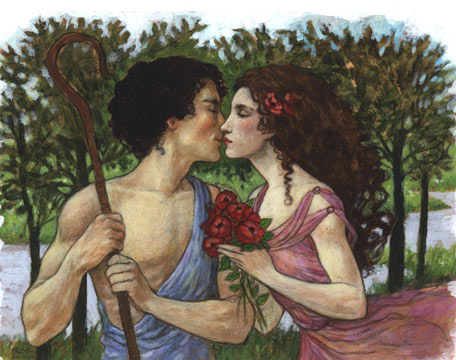
Their scheme is almost always the same: two young people promise each other eternal love and must overcome serious obstacles to see their union crystallize.
The first Spanish Byzantine novel, was written by Alonso Nuñez de Reinoso and is called Clareo and Florisea. It was published in 1552 and is mostly a translation of the novel by greek poet Aquiles Tacio, called Leucipa and Clitofonte.
El Peregrino en su patria by Lope de Vega, was one of the most popular of this genre.
lowing centuries, thanks, in part, to the translations made by the French writer and translator Jacques Amyot.
Because of the transcriptions he made of these works, they were rediscovered in early modern Europe and played an influential role in the formation of the modern novel, particularly the romance genre.
Ancient Greek Novel
The ancient Greek novel, is the starting-point or what the Byzantine novel is used for. Five of them have survived completely from antiquity, these are:
Adventures of Quéreas and Calyrroe of Cariton (mid 1st century), Adventures of Leucipa and Clithophon of Achilles Tacio (early 2nd century), Daphnis and Chloe of Longo (2nd century), Ephesian of Xenophon of Ephesus (late 2nd century) and Ethiopian also known as Theos and Cariclea of Heliodorus (3rd century).
But there are also many fragments preserved on papyrus or in quotations and summaries from Photius, an ecumenical patriarch of the ninth century.
The plots of these stories are usually relatively conventional, that is, they involve the heterosexual desire of a beautiful and virtuous young couple, who go through difficulties until they finally meet again and have a happy ending.
However, some of these works show more sophistication in the handling of narrative, character and intersex.
These authors had a great influence in the following centuries, thanks, in part, to the translations made by the French writer and translator Jacques Amyot.
Because of the transcriptions he made of these works, they were rediscovered in early modern Europe and played an influential role in the formation of the modern novel, particularly the romance genre.
Byzantine Literature
The Spanish Byzantine novel, is inscribed within what is known as Byzantine literature; this is also known as Greek literature of the Middle Ages, whether written within the space of the Byzantine Empire or outside its borders and is part of the so-called second period of the history of Greek literature.
Byzantine literature and modern Greek literature, which began in the eleventh century, have features that make them indistinguishable.
Under the Comnenian dynasty, the Byzantine writers of Constantinople in the 12th century reintroduced the ancient Greek Romantic literature by imitating its form and time, but Christianizing its content.
It is for this reason that Byzantine stories are traditional in structure (with complex twists of events taking place in the ancient Mediterranean, including ancient gods and beliefs), but are also very medieval, clearly belonging to the time of the Crusades, as they reflect the customs and beliefs of that time.
A gap of eight centuries separates the last surviving work of romance of late antiquity and the first of the medieval era.
Genres
Byzantine literature can be classified into five groups: The first three include representatives of this type of rhetoric that continues the ancient traditions: historians, chroniclers, encyclopedists, essayists and writers of secular poetry.
The other two include: ecclesiastical and theological literature and popular poetry.
Historians
The classical literary tradition, was what set the standards for the historians of the Byzantine period, the way in which themes are handled and the style of composition.
These works are concrete and lack passion or enthusiasm. Ardent patriotism or personal convictions, are rarely evident.
They are diplomatic historians, experts in the use of historical sources. Almost always, they are people who stood out in public life like Joannes Cinnamus, Nicetas Acominatus or Georgius Phrantzes.
The Byzantine historians come to represent, the social flower and the intellectuality of those times that made them quite similar to their Greek predecessors. Herodotus, Xenophon, Polybius among others, became their role models.
Many times the Byzantines chose a classical writer to imitate their method and style, however, most took more than one author as their guide, which resulted in a peculiar mosaic style that was very characteristic within the genre.
Chroniclers
Unlike historical works, Byzantine chronicles were intended for the general public, hence the difference in their origin, development and dissemination, as well as in their character, method and style.
While the roots of the chronicles have not been satisfactorily traced, their comparatively late appearance (6th century) and the suppression of the Hellenistic tradition, place their origin as quite recent.
The literature of the chronicles is originally alien to Greek civilization.
The first composition of this style may have been made by Syrians with little education and the first alleged prototype the “Chronography” of Sextus Julius Africanus, points to an Eastern Christian source.
It can be placed at the height of the Byzantine chronicle during the ninth century AD, only to decline abruptly thereafter.
The chroniclers helped to spread Byzantine culture to the Slavs, Magyars and Turks.
They are considered to be of great importance for comparative linguistics, since their diction and popular language make known the little education of both the author and the audience to which the work is addressed.
Encyclopedists and Essayists
The spirit of ancient erudition was awakened in the Byzantine Empire before it was in the West and was initiated by theologians and not by laymen, which is why this type of writing always had a scholastic spirit.
Byzantine literature tasted just as much of antiquity as it did of the Middle Ages.
The interest in ancient Greek literature manifested itself in Constantinople at the end of the ninth century.
Already by the 12th century, a period began in which a series of original writings, but imitating ancient models, revived the Alexandrian essay and rhetorical literature. Many writers of this time, show themselves with vigorous originality.
The humanism of the ninth and tenth centuries maintained a religious tinge as well as a hostile attitude towards the West.
In contrast, between the 12th and 14th centuries, many authors sought to break with orthodox classicism to achieve a true humanism. This made them the forerunners of the Italian Renaissance.
Secular Poetry
Poetry also had its prototypes, the Byzantines did not write lyrical or dramatic poems. Unlike prose, they did not follow the classical Attic period, they did not imitate Pindar or Sophocles.
They imitated the literature of the Alexandrian period, they wrote romances, panegyrics, epigrams, satires and didactic poetry following the models of Heliodorus, Achilles Tacius, Asclepiades among others.
The temperament of the Byzantine poets is much more similar to that of the Alexandrian writers and only one new type evolved independently: The begging poem whose main exponent is Theodore Prodomo.
For many historians, this type of distressing poetry is of great value, since it recreates the life of the street at that time.
The epigram was the only secular poetry that had a renaissance in Byzantine literature, this was at the time when the ecclesiastical poetry had its maximum perfection (sixth and seventh centuries).
This is considered then as the period of greatest flourishing in Byzantine scholarly poetry.
In the 12th century, its decline coincided with the emergence of popular poetry and the most popular genres were satire, parody, begging poem and erotic romance.
Byzantine Novel
The ancient Greek novel was imitated to create a new genre known as the romance novel or Byzantine novel.
Four writers of the 12th century were its greatest exponents: Eustatius Macrembolite, Theodore Prodomus, Constantine Manasses and Niketas Eugenians, whose works exist today.
These are Hysimine and Hysimines, Rodanthe and Dosikles, Aristans and Kallithéa and Drosilla and Charikles.
Ecclesiastical and Theological Literature
The first flourishing of Byzantine ecclesiastical literature is Hellenistic and part of an Eastern spirit. This period falls in the 4th century and is associated with the names of the Greek Fathers of Alexandria, Palestine, Jerusalem, Cyrene and Cappadocia.
His works, which cover the whole field of ecclesiastical literature, dogmas, exegesis and homilies, become canonical during this whole period.
Only three kinds of church literature that had not been developed in the fourth century show independent growth. These were the ecclesiastical poetry of the 6th century, the popular life of the saints of the 7th century, and the mystical writings of the 11th and 12th centuries.
One of the most important representatives of this literary genre is John of Damascus, who, in the opinion of the Byzantines, is the most important writer of canons.
He used Gregory of Nazianzus as a model, even reintroducing the principle of quantity into church poetry.
By the eleventh century, the study of hymns or Greek hymnology began to decline and pagan humanism was reborn. Later, Michael Psellus began to parody church hymns which became a practice that took root in popular culture.
The didactic poems thus took this form without being considered as blasphemous.
Popular Poetry
The capture of Constantinople and the establishment of Latin kingdoms in 1204 displaced or supplanted aristocratic and ecclesiastical controls over taste and styles of literature.
In response to these new influences, Byzantine popular literature moved in different directions. One of them was erotic poetry and its refinement, this was due to the influence of the love poetry introduced by the Frankish knights in the 13th century.
The Byzantines then imitated and adapted the romantic and legendary material that these Westerners brought. Italian influences led to the revival of drama.
Heroic poetry was also revived, although given a deeper romantic tone. The result was a complete uprising of popular ideals and a widening of the horizon as antithetical tendencies were eroded.
All this resulted in a complete reconstruction of the Byzantine types of literature.
Of all the varieties of art poetry, only the romance that became more serious and expanded further survived. From this material, abundant types of new poetry emerged, along with the narratives of love and heroism, popular love letters and even modern drama.
The Spanish Byzantine Novel
In Spain, the Byzantine novel had its heyday between the 16th and 17th centuries, being in many cases, translations of the ancient Greek novels.
Such is the case of the Spanish novelist Alonso Nuñez de Reinoso with his work Historia de Los Amores de Clareo y Florisea, from 1552. Remarkably, the author finds his inspiration in Leucipa and Clitofonte by the Greek writer and poet Aquiles Tacio.
Through this work, Nuñez de Reinoso had a great influence on Miguel de Cervantes when he wrote Los Trabajos de Persiles y Sigismunda, Historia Setentrional.
The theme to be dealt with in this type of novel is always the same: loves of youth, the inevitable separation of lovers, adventures, captivities, travels, exotic cultures and distant places, so that in the end the couple can meet again and their love crystallizes.
El Peregrino en su Patria, written by de Lope de Vega in 1604, is one of the most famous writings of the Byzantine novel in the Spanish language.
Other popular novels of this genre are: El viaje entretenido by Agustín Rojas (1603), Marcos de Obregón by Vicente Espinel (1618), Historia Peregrina y Ejemplares by Gonzalo de Céspedes y Meneses (1623) and the already mentioned Los trabajos de Persiles y Sigismunda, historia setentrional by Miguel de Cervantes (1617).

About Zoryham
Zoryham is a Political Scientist who has been a freelance writer and radio broadcaster for several years. Her niches include Music, Wellness, Healthy Lifestyle, Yoga, Personal Development, Animals and Product Reviews. When Zoryham is not writing, you can find her listening to a Rolling Stones album, her favorite band.